Goddamn You! Your kung fu is lacking...
Showing posts with label Rare. Show all posts

Sunday, 15 April 2012

The Lone Hero (1973)


Background:  Taiwanese basher starring Tien Wen Chung, Ling Fong Chiao, Chu Chiang Hua, Chang Ping, Sha Lee Wen and Kam Kong.  Distributed by Goldig Films.  Action Directed by Hsieh Hsing.  Produced by Alex Gouw.  This version is fullscreen, with custom English subtitles.

Story (SPOILERS): Fei Hsiung (Chu Chiang Hua) is a rebel fighting against Japanese rule.  He has lost his four brothers and father in the uprising, and carries his mother to safety on his back.

Pfft, family.  All they do is hold yer back.  

They reach his uncle's house, and settle in nicely.  Hsiung is engaged to his cousin, Li Ying, but feels guilty about what has happened to the family.


Meanwhile, a trio of local toughs, led by Kao, steal Uncle's fishing boat and beat up his workforce.


Kao returns to his Boss, Lee Tien Ho (Tien Wen Chung), and informs him that Uncle is waiting to speak with him about the boat-stealing outrage.  Lee is forced to cut short his session with his lass:

Snake fist?

Boss Lee explains to Uncle that the boat has been impounded for ten days, because Uncle has violated some random shipping regulations.  Uncle won't accept this, and they get into a quarrel.  Boss Lee tells Uncle to sod off, and orders Kao to chuck him out and burn his vessel for his impertinence.

The subs can be rather amusing.   

Kao's men give Uncle a kicking, causing the fishermen to rush in to defend their employer.  A brawl breaks out in the courtyard, and spills out into the open.


Despite warnings that he should stay hidden so that no-one informs the Japanese of his presence, Hsiung rushes to defend the fisherman, killing Kao, and attacks Boss Lee in his compound.

Calm down.  Take a seat.

After he dishes out a kicking, Hsiung forces Boss Lee to reveal the whereabouts of the boat.  On the way, he meets Boss Lee's lass, who remembers Hsiung from the past and takes an immediate fancy to him.


Licking his wounds, Boss Lee visits Uncle and offers him a sizeable fee to borrow his boat for ten days, on the proviso that Hsiung is kept on a leash.  Uncle refuses when he finds out that the boat will be used for smuggling.  Boss Lee kidnaps him.


After various threats, Hsuing is powerless to help - or so he thinks.  He manages to persuade Lee's girl to take him to Uncle, on the understanding that he will marry her.  After the rescue, he tells her the truth - he cannot marry her because he is promised to another.


Hsiung decides to hunt down Boss Lee, and persuades a lackey to take him to the smuggler's warehouse.  Boss Lee learns of this, and his two best fighters throw dice to decide which one is going to tackle Hsiung, and which one is going to nob a lass.


This leads to a bizarre scene, where the action keeps cutting between Hsiung and the expert trading blows, and the other fighter getting a mouthful of naked girl.  Hsiung chases the fighter back to the warehouse, and after another brawl they manage to trap him in a wooden crate, nail the top down, and chuck him off a cliff into the sea.

Wave goodbye, rebel scum.

Unfortunately for Boss Lee, Japanese soldiers arrive and demand that he hands over Hsiung.  Boss Lee retrieves the crate from an inlet, and takes it back.  Hsiung bursts out and kills all except Boss Lee, who escapes.  He rushes back to Uncle's house and gathers Li Ying and his mother to escape on the boat.  They are intercepted by more soldiers, who have killed Uncle for hiding the rebel, and Hsiung gets shot while disposing of them.

This is possibly the slowest exchange of blows in the film, with movements that don't run much faster than this still.

Lee is waiting on the boat, and there is a scuffle to the death.


Despite his injury, Hsiung prevails, and the boat chugs off into the distance with Boss Lee's lass watching on longingly from the shore.

No bed kung fu ... for you.

Impressions:  Erm, I'm not sure.  The central conceit of the story is run of the mill - Japanese occupation, smuggling, and a corrupt local gang boss - but the film moves at a reasonable pace.  The locales are grotty and unimaginative, but some interesting camera angles occasionally liven this up.  The sound loses synch at some points - with punch sounds being heard well off the pace.

The main problem lies with the central character.  Chu Chiang Hua, according to hkmdb, only made this single film.  Surely that can't be correct?  Or can it?  He spends most of the film looking bewildered and vulnerable, hardly the double-hard bassa he's supposed to play.  This 'sensitive tough guy' performance would be ok - he has lost most of his family, after all - if his fights weren't so hit and miss.  It speaks volumes that the faster, more energetic fights in this film were between other people.  Any fight scene featuring Hsiung is slow and methodical, and often unconvincing.  It's as if his co-stars had to hang back to deliver very deliberate, measured attacks.  I'd expect a central badass figure to be a lot more powerful, violent, and furious than Chu Chiang Hua presents.  It seems as if the fight choreographer was stifled by the limitations of the lead.  Maybe I'm being unkind.  I'm not even vaguely qualified to comment on stances, posture, etc, of real martial arts, but on screen, the main character's action scenes are, to my mind, not as exhilarating as they should be.  There's no real sense of justice and revenge in the blows.  Shame, as I expect as a dramatic actor he'd be fine.


As such, my enjoyment of this film was limited.  The print is good (bar what-looks-like the same droplets of water on the print in the same position throughout, but that's a minor quibble), the subtitles were fine, and as bashers go, it's not bad.  I feel bad that the central character dampened my enthusiasm for the film.  His shocked good guy routine could have been a winner if his fights were livelier, faster and more powerful.

Saturday, 4 February 2012

Story of the Thirty-Six Killers (1971)


Background:  This is an extremely rare film sourced from a German collector.  I acquired it as part of a consortium.  It has been cited on the 'wanted' lists of many collectors for years.  All images are snapped through vlc.  


Story: I'm not going to go into too much detail here as it's a reasonably good story with a few twists and turns.  A full synopsis would spoil it.  The film starts with two brothers pelting through the countryside on horseback. One, Meng Liang (Pai Ying), returns back home to Ma as the other, Hsiao Shun, takes off into town.  It's a typically ramshackle rural setting.  As Hsiao arrives he finds bodies everywhere, with a group of bandits forcing themselves on the womenfolk.  He intervenes, killing all but one bandit and saving a young woman.

Unfortunately, he has killed one of the sons of Lord Lo, a local shitbag.  Hsiao is recognised as the brother of Meng Liang.  A surviving bad guy returns the son's body to Lord Lo.  When the Lord asks who has killed his son, the scumbag says that "It was .... Meng" before dying (presumably before he could finish the sentence).  Naturally, this means that Lord Lo now thinks that Meng Liang is the culprit, rather than his brother.  Coincidentally, back at home Ma is furious with the boys.  Meng decides to protect his brother and take responsibility for the event, compounding his guilt in the eyes of friend and foe.


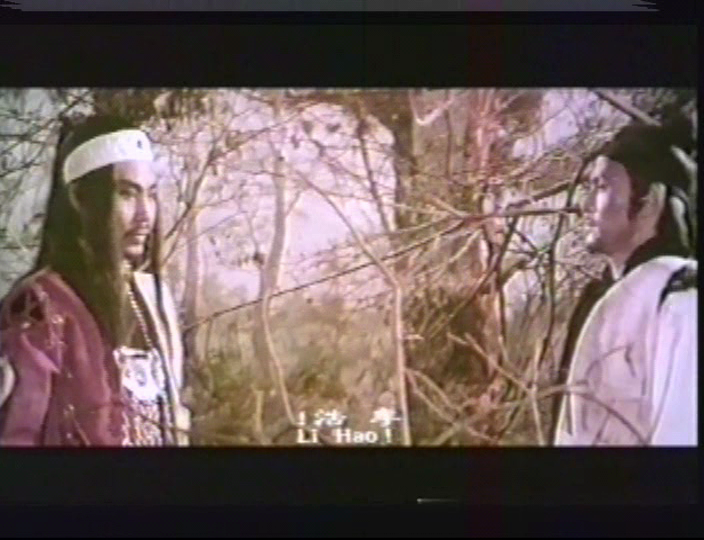
After fleeing, Meng splits up from the group and encounters a mysterious assassin in a wooded swamp, named Li Hao (Fatal Hand).  Li recognises Meng as the son of renowned swordsman Meng Tung San (the Soul Sword).  He explains that Lord Lo will pay 100 taels of gold for Meng's head.  After a brief stalemate, Meng asks Li for three days to sort out his affairs, promising to return to face him.  Li takes Meng's word of honour, and leaves.


In town, the group hide away at their uncle Lin's house, but their cousin, Erh Niu, informs them that he's been captured and imprisoned on money-related charges.  The two brothers and cousin decide to try to rescue him, and overhear Lord Lo and his entourage of henchman planning to overthrow the ruler and claim power for themselves.  This positions Lo's vendetta against Meng in the wider context of a rebellion plot.

That's about the first 25 to 30 minutes, and I'll go no further.  There's some extraordinary behaviour from Li Hao throughout the rest of the film, and the tone of the story is unrelenting.  It's dark and serious, and pulls few punches with characters.  I don't know enough about early 70s films to know how common this angle, pace and tone was, but it certainly held my attention throughout.  The ending was pretty damn fine, I thought, and one character seemed to demonstrate some real growth.

Fights: I've heard it said by a few people that rumour suggested that the action in 36 Killers is quite high level for the time.  I have no idea about that.  However, I can say that I found the swordplay to be a lot faster than late 60s indie efforts I've seen.  There's a great scene where the two brothers are trapped on a closed walkway, and henchmen throw dozens of darts at them, which are fended off expertly by Meng wielding some kind of handle-based spinning deflector.  The picture was so unclear (I'll come onto that in a minute) that I can't be sure what it was, but as a spectacle it was highly effective.  The other battles are busy (without being too stylish or gruesome) and match the pace of the film well - reasonably intense but not edge-of-your-seat.  The end engagements are rather good - including some inventive choreography involving a large wooden trunk with swords embedded in it.

Production/ Print Quality:  The settings are typically indie - run down villages, a well-guarded stronghold, dusty countryside - but two design choices stand out.  The first one seems to be in a near-desert-like locale, and adds to the drama of the scene.  The other is a personal favourite.  Meng meets Lo in the pouring rain.  He stands motionless, looking bad-ass, before turning to face his nemesis.  As rain scenes go, it's not up with Sword of Justice or What Price Honesty, but it's genuinely atmospheric and well-filmed.


One major problem with this film isn't a problem with the film - it's a problem with the copy.  As noted, this movie is rarer than hen's teeth, so beggars can't be choosers.  I'll confirm that it's totally watchable - I understood most of the subtitles easily enough and could work out what was going on 99.9% of the time.  However, there are problems.  For starters, the colouration of the print is often poor - whole scenes are in blossoming greens, pinks and oranges:


Through part of one reel, the subtitles are cut in half horizontally, though thankfully this only happens for a short time, and they're still readable.  Another problem that only occurs on a solitary occasion (that I can recall) is a break-up of the image into an odd blue patchwork of distortion:


Above is Pai Ying preparing for a fight.  Trust me.  Finally, we have common shifts in focus throughout the film.  In one scene, the image can blur and re-focus dozens of times.  It's not as off-putting as it sounds, but it can lead to some subtitles being difficult to read:


In spite of this whinging, let me reiterate that this isn't as big a deal as it sounds.  If I went through a checklist of 'musts' for a film as rare as this, I'd say:

Could I understand it?  Yes.  The subtitles are shown fully - no cuts offs. 
Could I see what was going on?  Yes - issues did not last long.  The discolouration is charming, in a way.
Did I enjoy it?  Absolutely.  

And that's the bottom line.  I don't give a toss about the print issues for 36 Killers.  Sure, I'd like to have a glass print, who wouldn't?  But that's not going to happen.  Instead, I'm deeply gratified to have had the opportunity to watch this film; one I'd read about but thought the chances of seeing were slim.

Thursday, 2 February 2012

Fusubs - Brief but Brilliant

I remember my first experience with Fusubs rather well. One of the team - Roger Judd Jr - was a relatively recent trade acquaintance. He's a very trustworthy person, and when I spied a thread on kung fu cinema forum about new custom subtitled projects from a team including Roger, I knew it was going to be good.

I wasn't quite prepared for how good.

Fusubs were formed in February/March 2010 by Samson Price, who came up with the idea of forming a subbing group, Roger, Bob O'Brien, and Gerald P. Crane (his wife joined afterward to help him with the Chinese translation). A trans-Atlantic group, they identified an opportunity to release new versions of old movies. The market is, and continues to be, dominated by re-releases of Shaw Brothers films, but Fusubs championed an approach that saw them release a hugely-impressive total of 21 largely-obscure movies in about 18 months. All were custom-subtitled and meticulously produced.

The first couple of dvds I ordered arrived remarkably quickly from Canada, packaged securely with custom covers. These covers were superb. They included a detailed synopsis of the film, the film's year of production, cast and director, the aspect ratio of the picture, and the specifications of the project. An option for white OR yellow subtitles provided viewers with a neat choice. I myself prefer white subtitles, but sometimes on prints with burnt-in subtitles they become unreadable - so yellow was a most welcome option.

On average, a single title took around 60 to 70 hours to produce. Gerald and Hana translated the raw Chinese dialogue. Samson handled the tech work; subbing, timing and authoring the dvds, and even correcting the colour where possible to enhance the picture. Bob designed the cover, while Roger sourced most of the prints, translated the films only available in dubbed French language, and handled distribution matters. These dvds were far, far superior to most kung fu dvds releases. When I think of some of the rank-bad spelling mistakes, the lack of information, and the general damn-shoddy workmanship that's paraded on the front of some releases - well, the professionalism of Fusubs showed just how pisspoor these other efforts were.

Costs were low for the team, but the energy and effort spent were massive. The members had a great chemistry, which was essential for seeing projects that required a huge investment of free time through to completion. As I settled down to watch that first film, I could sense the care and attention that had gone into restoring and bringing to life these old films. A neat little title screen led into the movie, which was invariably the best print available. The subtitles were clear and well-written, not to mention well-timed. Professionalism.

Why do I keep referring to Fusubs in the past tense? Unfortunately, the group are no more. This is a tragedy for fans of films that exist only in raw language prints. Sadly, the lack of support from genre fans - the very people to benefit from their efforts - led them to call it a day. They retained a core fanbase of about 10 people, but a poor response to some hugely-demanding projects sapped their enthusiasm for the venture.

Nevertheless, depite a failure to achieve greater success, I'm reliably informed that the team have no regrets. Quite right. They did like-minded fans a great service. I have watched films that I hadn't previously been able to understand. That's their legacy. I hadn't even heard of The Eight Dragon Sword before Fusubs. Now, I not only had it, but could actually watch it, understand it, and enjoyed it immensely. It is one of my favourite swordplay films, and that's thanks to Fusubs.

Fusubs released the following titles, all still available from r.judd@videotron.ca:

The Mysterious Knight
The Battle for the Republic Of China
Carry On Wise Guy
The Rats of Hong Kong
Ma Su Chen takes Revenge
The Armless Swordsman
To Kill A Mastermind
I Will Finally Knock You Down, Dad!
The Close Encounter of the Vampire
Adventure in Denmark
The Third Sword
From the Highway
Dragon and Tiger Joint Hands
Heroine Susan
Lion's Heart
The Dragon Tamers
Killers on Wheels
Revenge of the Shaolin Kid
Tigresses
The Patriotic Heroine
The Eight Dragon Sword


Many thanks to Roger Judd Jr for his assistance in the compilation of this post.

Monday, 30 January 2012

Massacre Survivor (1979)


Chung Wai Motion Picture Co. Ltd

Background: In early 2010, a consortium on a well-known genre forum contributed a considerable sum to acquire copies of this rare film from a private collector.

Briefly, the story: A rebel General (Wong Ching) tries to enlist the support of a local master, to participate in an uprising against the Emperor. He is refused, so he returns later to remove this security risk. His military forces kill everybody except the daughter Kao (Shih Szu), who flees as, quite literally, the massacre survivor. She pleads with a temple of monks to teach her the skills vital to gaining her revenge. She is taught crane-style by one monk (Shih Ting-Ken) and a specialised variety of weapons training by another (Yuen Cheung-Yan) Meanwhile, the Prince (Chung Wa) and his aide (Wong Chung) encounter assassination attempts on the road. They cross paths a few times with Kao until they release they have something in common.

Review: Excellent.

The only other films I've seen that compare to the tone of Massacre Survivor are Rebellious Reign and Eight Diagram Pole Fighter. Both of those films are relentlessly serious, and punch a heavy dramatic weight. The pain, frustration and anger that the lead actress displays here is clear and affecting. The scene where she howls on the steps of the temple, with the rain hammering her and the surroundings, is superb. It is very atmospheric and drags the audience into her plight. The pacing of the film is spot on - there was a solid focus on every part of the story. The fights are a good length, the conversations concise and interesting, the emotional sequences are well handled, and the training bits are exciting.

The sets and locales are also splendid. The opening march through the rain is particularly impressive. I noticed the sets are used to good effect to juxtapose the characters and their situation: The evil rebels sit in luxurious surroundings, surrounded by blossom trees, compared to the stripped-down pain and fury Shih Szu forces herself to go through in the temple training sequences.

The shapes work is good, with plenty of flourishes and stylish movements.  Similarly, the weapons work is super - I loved the half-moon blade things. And the spiky hoops - wow! Standout fights include the scene featuring the Bamboo Mountain Four, and rumble in the restaurant.  Both are highly kinetic and mix styles nicely. There doesn't seem to be too much wire-work in this film, and some effects seem to have been accomplished by reversing the footage. Director Dung Gam-Woo, and choreographers Corey Yuen Kwai and Yuen Cheung-Yan have done a terrific job keeping the action fast and fresh.

After all the hype I was preparing myself to feel let down by Massacre Survivor. But that didn't happen. It met my expectations in some respects, and surprised me in others. I never expected such a serious tone, but I'm so pleased it's turned out that way, because the other two films I mentioned before are among my favourites. The acting and casting are uniformly good, the pace of the story is superb, the choreography very good (from the perspective of my limited understanding, anyway) and the production values quality.

The technical quality of the print is passable. There's moments where it's very reasonable, with fuller colours; but at other times it's pinky/brown-er than normal.  There's also a lot of wear on the film, but that just adds to the charm for me. It really does feel like what it is - a lost classic! The subtitles are fine - most are written in reasonable English and are usually readable.  The only issue is when the text is positioned in front of a white background.

Adapted from an old review posted on kung fu cinema forums.